
 Design Custom NFPA Diamond Placards for Hazmat
This easy-to-use builder lets you create custom NFPA hazmat diamond placards by selecting hazard ratings for health, flammability, instability, and special conditions -- ensuring accurate, standardized hazard communication for emergency responders and safety personnel. Design ID Pro lets you customize your NFPA fire diamond with ratings for your specific materials. Choose materials and sizes to suit your workplace requirements.
Design ID Pro TutorialMake Custom NFPA 704 Hazard Placards Online – 5 Sizes, 5 Durable Materials
Quickly identify chemical and fire hazards with custom NFPA Diamond signs and labels that meet NFPA 704 standards. The new Design ID Pro online design tool makes it easy to create compliant NFPA 704 placards with your exact hazard ratings — ready to ship fast.
Whether you are labeling a chemical storage room, stationary tank, lab door, or exterior access point, NFPA placards show risk at a glance. Workers, inspectors, and emergency responders can assess risk at a glance.
How To Customize Your NFPA Diamond:
1. Select a material – 5 options (details below)
2. Choose a size for your diamond – 5 choices
3. Select Hazard Classification numbers for each section (information below)
4. Select a Special Hazard symbol – 11 options (information below)
5. Select a background for the back – 13 options
6. Input the quantity you need
Then review and click Add To Cart – Easy!
You can email yourself a proof to save or share. Then save your NFPA placard for easy re-orders in the future.
Order Your Custom NFPA 704 Diamonds Today
Understanding NFPA Hazard Ratings
The National Fire Protection Association (NFPA), under Section 704 of the National Fire Code, defines the system for identifying hazards associated with chemical materials.
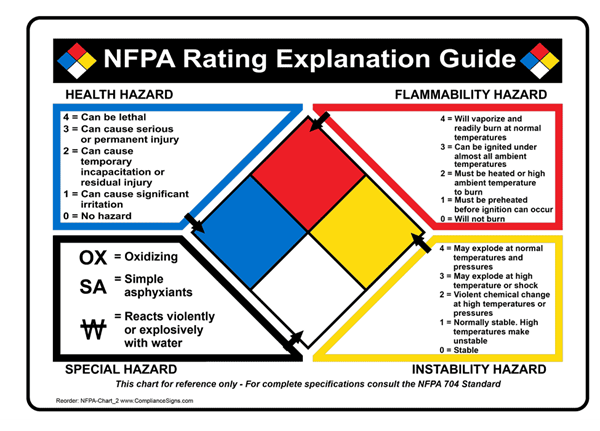
The NFPA 704 Diamond - also known as the Fire Diamond — is a color-coded symbol that provides quick, visual hazard information to emergency responders, safety officers, and anyone handling hazardous substances. It uses a four-color, diamond-shaped symbol to communicate chemical hazards during emergencies such as fires, spills, or explosions.
Each quadrant of the fire diamond provides critical safety information:
- • Blue – Health Hazard
- • Red – Flammability
- • Yellow – Instability (Reactivity)
- • White – Special Hazards
The blue, red, and yellow sections display a numerical rating from 0 to 4:
- • 4 = Severe hazard / extreme danger
- • 0 = Minimal hazard
The white section is for special hazard symbols such as:
- • OX (Oxidizer)
- •
W(Water reactive) - • SA (Simple asphyxiant gas)
This system provides a clear, visual warning to first responders and safety personnel to help them make fast, informed decisions.
The best source for NFPA hazard ratings is the Material Safety Data Sheet (MSDS/SDS) provided by your chemical supplier. NFPA 704 ratings are typically found in Section 16 of the MSDS. Additional references include:
- • NFPA Fire Protection Guide on Hazardous Materials
- • NFPA 704 Standard System for the Identification of the Hazards of Materials for Emergency Response
- • Hazardous materials databases and safety reference manuals
Always verify ratings with up-to-date documentation before creating signage.
Do NOT use the GHS hazard category numbers shown in section 2 of HazCom-compliant SDSs as NFPA 704 Hazard Ratings. GHS numbers are not the same as NFPA hazard ratings. (For GHS, 1 is most hazardous - the opposite of NFPA 704.)
Notes On Special Hazard Symbols:
Although NFPA diamond labels commonly are created with a variety of symbols, only three symbols are authorized by the NFPA for use on Hazmat Diamonds: OX, SA and W. These approved symbols are indicated on the dropdown menu above.
| Authorized Special Hazard Symbols | Non-authorized Symbols** |
|---|---|
| OX - Oxidizer | ACID - Acid |
| SA - Asphyxiant | ALK - Alkaline |
| COR - Corrosive | |
| COR+OX - Corrosive Oxidizer | |
| COR+OXY - Corrosive Oxidizer | |
| CRY - Cryogenic | |
| OXY - Oxidizer Agent | |
| RAD - Radioactive |
**Emergency responders in your area may not recognize unauthorized fire hazard symbols because they are not defined in NFPA 704. Before using these symbols, consult your local emergency response team.
Product Specifications
Your custom NFPA Diamonds are proudly made in the USA using durable materials for long life.
Material Options
Dura-plastic - indoor or outdoor use
- .060 in. Semi-rigid polycarbonate material
- Resists abrasion, humidity, and chemicals
- Service temperature range: -20° to 140°F
Aluminum - indoor or outdoor use
- .040 in thick enamel-coated aluminum
- Withstands splashes and wash downs
- Resists chemicals, abrasions, and abuse
- Rust-free
- Service temperature range: -40° to 140°F
Adhesive Dura-Poly - indoor or outdoor use
- Flexible 4-mil thick poly-composite
- Resists abrasion, humidity, chemicals, solvents, and sunlight fading
- Permanent acrylic adhesive back with peel-off liner
- Adheres to smooth, curved, and irregular surfaces
- Service temperature range: -40° to 176°F
Adhesive Poly - Indoor or short-term outdoor use
- Flexible 4 mil poly with acrylic adhesive
- Non-glare surface
- Resists moisture and UV
- Economical choice
- Service temperature range: -40° to 176°F
Magnetic Vinyl - Indoor or outdoor use
- 20-mil synthetic rubber base with UV protection coating
- Magnetically clings to non-ferrous metals
- Ideal for frequent changing of signs on vehicles, tanks & vessels, bins, shelving
- Flexible to mount on curved surfaces
- Service temperature range: 0° to 160°F
Available Sizes:
- 6 x 6 in.
- 10 x 10 in.
- 15 x 15 in.
- 24 x 24 in.
- 30 x 30 in.
If you need other sizes, please contact us for a quote.
Note: Plastic and aluminum signs will include mounting holes at each corner.
Where Should I Post NFPA Diamond Signs?
NFPA Diamond Signs and Labels are typically placed on building exteriors, doors, and storage tanks, ensuring they are clearly visible during a fire, chemical spill, or other emergency. According to NFPA 704 guidance, signs must be placed in locations approved by the authority having jurisdiction (AHJ). Review Section 4.3 of NFPA 704 for location guidance. At a minimum, they should be posted:
- • On two exterior walls with access to a building or facility
- • At each access point to a hazardous room or area
- • At principal entrances to exterior storage areas
- • On stationary containers and above-ground tanks
- • At entrances where hazardous materials are stored, used, or dispensed in quantities requiring a permit
If emergency personnel could enter from multiple points, multiple signs should be installed. Proper placement ensures the sign is readily visible and appropriately sized for the viewing distance.
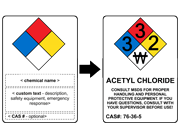
Need NFPA Diamond Signs with Chemical Name, CAS # or Custom Text?
When you need more than a simple diamond, you can make signs with the NFPA diamond and chemical name, CAS# and other information.
NFPA 704 Diamond FAQs
When are NFPA Diamonds Required?
NFPA 704 labels are required whenever another regulation or code (Federal, state or local) requires their use. OSHA and fire codes widely reference NFPA 704. The NFPA 704 does not specify WHEN labels must be used -- it tells HOW to label when another agency requires NFPA labeling.
NFPA codes that require 704 labels for specific occupancies, storage, and hazardous materials, include:
- • NFPA 1 - Fire Code
- • NFPA 30 - Flammable and Combustible Liquids Code
- • NFPA 45 - Standard on Fire Protection for Laboratories Using Chemicals
- • NFPA 55 - Compressed Gases and Cryogenic Fluids Codes
- • NFPA 400 - Hazardous Materials Code
Some facilities install NFPA 704 placards regardless of actual requirements to provide additional information about material hazards on their sites.
Can I Find Hazard Ratings in the NFPA Standard?
No. NFPA 704 does not include hazard ratings for specific chemicals. Hazard evaluations should be performed by persons who are technically competent and experienced in the interpretation of hazard criteria identified in the Standard. A qualified person can determine the ratings for a material by comparing a manufacturer-supplied material safety data sheet (MSDS) to the NFPA criteria. Some MSDSs include NFPA 704 Diamond information or rating numbers.
How Do I Determine NFPA Hazard Ratings?
Ratings must be determined by a qualified safety professional. Compare Material Safety Data Sheet (MSDS) information against NFPA 704 criteria. The NFPA says the following sections of a MSDS should be reviewed when determining hazard ratings:
- • Health – Sections 2, 4, 8, 9, 11
- • Flammability – Sections 2, 3, 9
- • Instability – Sections 5, 7, 10
- • Special Hazards – Sections 5, 9, 10, 11
NOTE: Do NOT use the GHS hazard category numbers shown in section 2 of HazCom-compliant MSDSs as NFPA 704 Hazard Ratings. GHS numbers are not the same as NFPA hazard ratings. (For GHS, 1 is most hazardous - the opposite of NFPA 704.)
What Size NFPA 704 Label is Required?
Sign or placard size depends on the distance at which the hazard ratings must be legible. Chapter 9 of NFPA 704 gives guidance on the size of the hazard ratings relative to the size of the placard. It also gives the minimum size of ratings based on the distance at which the ratings are legible. Your local jurisdiction may have minimum size requirements.
NFPA Diamond Resources:
* Learn why the NFPA Diamond is important at SafeWork Insider
* Review our Resource Bulletin on NFPA 704
* NFPA Fire Protection Guide on Hazardous Materials
* NFPA 704 Standard